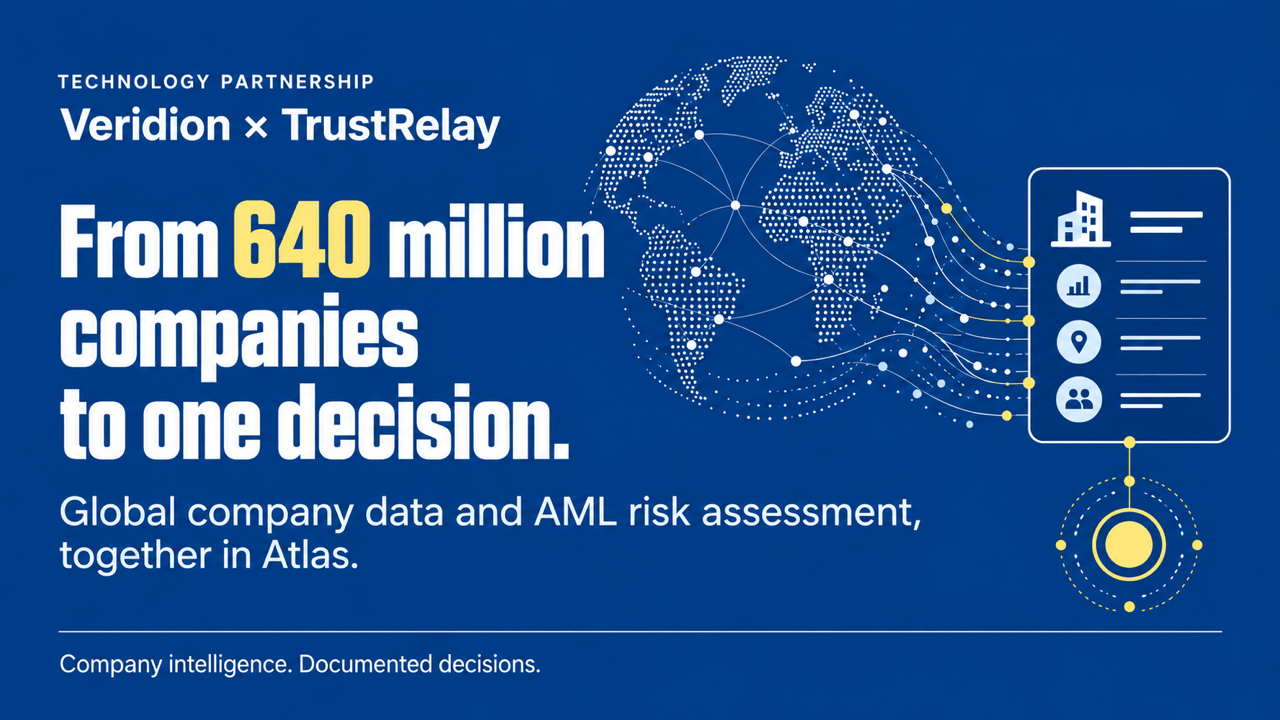

Veridion’s continuously updated data on more than 640 million companies is coming to TrustRelay’s Atlas, so compliance teams can see what their corporate clients do and where they operate, ahead of the EU AML Regulation, which applies on 10 July 2027.
Bucharest, 6 October 2026 – Veridion and TrustRelay today announced a technology partnership. Veridion maintains a continuously updated graph of more than 640 million companies worldwide, and TrustRelay, a RegTech startup, builds Atlas, a compliance platform for assessing the money-laundering risk of corporate clients. TrustRelay is integrating Veridion’s company data into Atlas. Compliance teams will see what a corporate client does and where it operates, next to the ownership structure Atlas builds from registry data, sanctions and PEP screening and an AML risk assessment with its regulatory references.
The problem is the data
In PwC’s EMEA AML Survey 2026, 89% of electronic and virtual payments firms named data quality as the main barrier to adopting AI and new technology in AML, as did 64% of banks and insurers. The same survey of more than 500 firms in 40 countries found that only about a third of EU respondents expect to be ready for the EU AML package by 10 July 2027, when the EU AML Regulation (AMLR) applies.
AMLR raises the bar on exactly that data. Institutions must understand the purpose and intended nature of each business relationship, assess each client’s risk, including what it does and where it operates, and keep client information current: at least once a year for high-risk clients, at least every five years for the rest, and sooner when relevant circumstances change. For a portfolio of a few thousand corporate clients, that can mean hundreds of reviews a year.
Three questions, one profile
Veridion supplies company intelligence; Atlas connects it to the evidence and risk assessment behind the analyst’s decision. Together they answer three questions every compliance team asks about a corporate client.
What does the client actually do? A registry shows who owns a company. Veridion shows what it sells, which industries it operates in and where it has locations. Atlas puts that next to the activity the client declared, so analysts can spot the differences.
Is there a real business behind the registration? Little trace of an operating business, such as no website or products identified in the sources checked, can be a reason to look closer, especially when the ownership structure seems unusually complex for the business the company declares. Atlas puts these signals in front of the analyst, next to the ownership structure, as a prompt to investigate rather than a verdict.
Where does the client really operate? A company registered in one country can run its business from another. Veridion maps where companies operate in nearly 250 countries and territories, so analysts can see activity in high-risk jurisdictions and weigh it as a geographic risk factor.
Atlas keeps the source of the data it uses, and its risk assessment documents the regulatory references behind it, such as AMLR and the EBA risk-factor guidelines, so the analyst’s decision can be explained to an auditor or a supervisor.
“Compliance teams don’t lack rules; they lack reliable data about their clients. AMLR asks every institution to understand its corporate clients and to keep that understanding current. Veridion gives us a richer view of companies’ activities and operating locations, and Atlas supports a risk decision that can be explained to an auditor,” said Valentin Stoican, founder of TrustRelay.
“A registry tells you a company exists and who owns it. It doesn’t tell you what the business actually does or where it operates, and that’s usually where the risk is. That operating side is what we map, for all the world’s hundreds of millions of companies, and we keep it current as they change. Next to Atlas’s ownership and screening work, it means an analyst sees the entire business behind the registration, not just the paperwork. said Stefan Gergely, Head of Growth at Veridion.
Availability
Veridion data will be available to Atlas customers from the second half of October 2026, alongside the registry and data providers they already use. Financial institutions preparing for AMLR can request a demonstration at demo@trustrelay.eu.
About Veridion
Veridion is a living digital replica of the business world, delivering decision-grade company data for enterprise-scale systems. Its continuously refreshed graph tracks 642 million companies across 249 countries, resolving each one into a connected structure of legal registrations, operating locations and corporate hierarchy, with 461 attributes per company. Rather than a periodic snapshot, Veridion re-derives records as the world changes, so what you query today reflects what is true today. Every data point traces back to its source. Teams across market intelligence, insurance and risk, supply chain and ESG build on Veridion through its product and APIs. Learn more at veridion.com
About TrustRelay
TrustRelay (TRUST RELAY SRL) is a Romanian RegTech startup incorporated in Bucharest in 2024 and a member of the Romanian Fintech Association (RoFintech). Its Atlas platform helps financial institutions and other obliged entities assess the money-laundering and terrorist-financing risk of their corporate clients. Atlas brings together registry data, the ownership structure and beneficial owners, sanctions and PEP screening and open-source investigations, with a documented risk methodology and an audit trail of evidence and decisions. Customer data is hosted in the European Union. More information: trustrelay.eu.
Media contacts
TrustRelay: Valentin Stoican, founder, valentin@trustrelay.eu
Veridion: Stefan Gergely, Head of Growth, stefan.gergely@veridion.com